Table of Contents
Get our free local reporting delivered straight to your inbox. No noise, no spam — just clear, independent coverage of Marblehead. Sign up for our once-a-week newsletter.
The Marblehead School Committee Budget Subcommittee on Jan. 29 reviewed a fiscal year 2027 budget proposal that would eliminate five teaching positions and one maintenance worker if the district receives no additional revenue beyond level funding from the town.
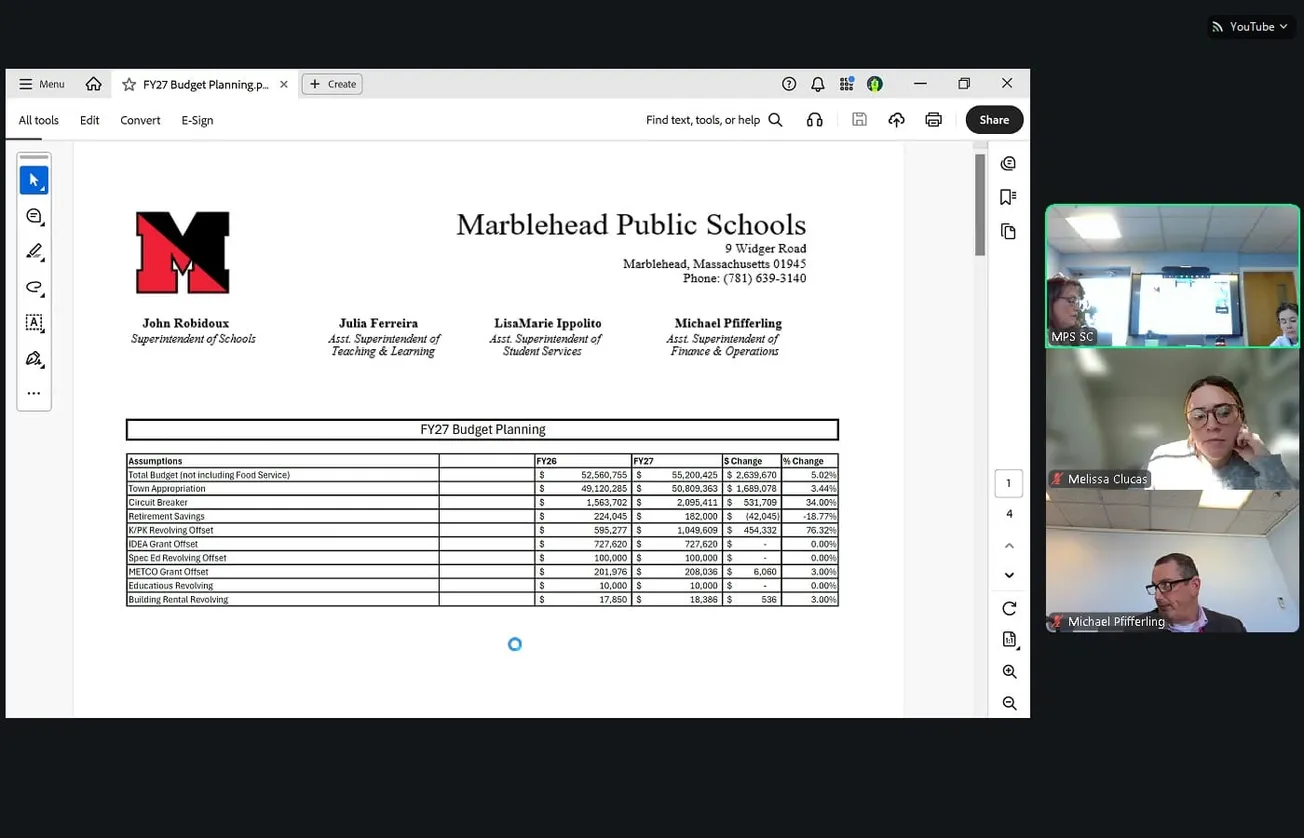
The proposed budget would hold the town’s appropriation flat at approximately $49.1 million — matching the fiscal year 2026 amount — rather than the $50.8 million needed to maintain current service levels. That level-service budget would have represented a $1.7 million increase over the current year, according to budget documents.
Superintendent John Robidoux and Michael Pfifferling, assistant superintendent of finance and operations, presented two rounds of budget adjustments totaling approximately $1.7 million in reductions and funding shifts to bring the district within $806 of the level-funded target.
You’re able to read this work free because 96 readers make it possible through monthly and annual contributions — and we endeavor to reach 100 members by Jan. 31 to keep this journalism strong. Click here to become an Independent member.
Robidoux indicated that if additional funding became available, the district would prioritize restoring the five teaching positions.
“If we had funding coming back, those first five spots up there would be where we would address first,” Robidoux told subcommittee members.
Finance Committee member Molly Teets, attending as a guest, noted the district may need to consider a tax override.
“I personally think, having done these long-term presentations now for the town two years in a row, that a longer-term approach should be taken as you think about an override,” Teets said.
Pfifferling cautioned that the adjustments assume no new revenue sources materialize before town meeting.
“I’m not celebrating, because FY 28 is a totally different story,” Pfifferling told the subcommittee. “If something doesn’t give, we’re looking at substantial work to make our budget work.”
Teets praised the district’s preparation: “At the State of the Town, we heard the fiscal situation that the town is in right now, and the schools have already done a lot of the hard work, the analysis.”
The second round of cuts, which officials described as reductions that “are going to hurt,” includes eliminating one elementary teacher position, one teacher at Veterans Middle School and three teachers at Marblehead High School. Those five positions represent approximately $375,000 in savings.
Robidoux said the district hopes to avoid layoffs through attrition.
“Say we have 10 English teachers at the high school, and we were to cut one and make it nine English teachers. How impactful is that to classroom size?” Robidoux said. “If you go from 21 kids to 23 kids, not that big a deal. It’s a much bigger deal at elementary level.”
The superintendent emphasized that “elementary teacher does not necessarily mean classroom teacher,” suggesting some cuts may come from non-classroom positions. Union leadership has not yet been informed of the specific positions targeted.
One maintenance worker position would be eliminated, saving approximately $71,000. Pfifferling said the district currently employs four maintenance workers and a supervisor.
“This one hurts, because I think we’re doing a better job of maintaining our facilities from the inside,” Pfifferling said. “This is one that is going to impact our buildings. To what level is still unknown.”
Other reductions include cutting one general education instructional assistant, saving $37,000; reducing a speech and language pathologist from full-time to 0.6, saving approximately $41,000; and eliminating vacant positions in special education teaching and an applied behavior analysis coordinator, saving approximately $77,000 each.
The district also proposed prepaying $800,000 in out-of-district special education tuitions instead of the planned $1 million, freeing $200,000. Utility reductions account for approximately $120,000 in savings.
The first round of adjustments relied primarily on shifting costs to revolving funds and grants. The district increased its draw from the kindergarten and pre-kindergarten revolving fund from approximately $595,000 to more than $1 million and applied an additional $500,000 from a larger circuit breaker reimbursement.
Pat Franklin, also from the Finance Committee, clarified that the level-funding directive came from town officials, not the Finance Committee.
Teets explained: “Last year and the last couple years, we’ve set up a framework where available revenue is split 50-50 between the town and schools.”
The budget will be presented to the full School Committee on Feb. 5. A public hearing is scheduled for Feb. 26, with a vote expected March 5.
Officials warned fiscal year 2028 would present greater challenges. Asked about another level-funded year, Pfifferling called that scenario “disastrous.“